

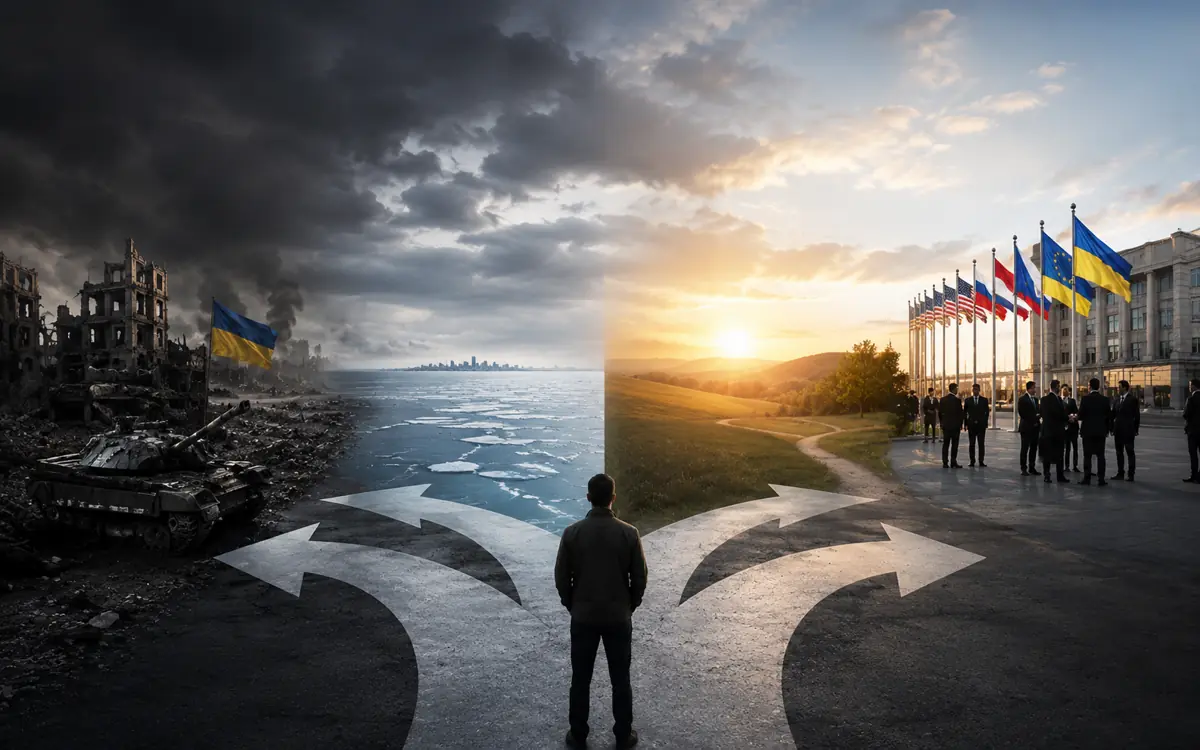
The question of a possible end to the war has once again become one of the main topics of world politics. After a series of statements by Western leaders, new diplomatic contacts and discussions of possible negotiations, the topic of a peaceful settlement is increasingly appearing in the international media. But behind the loud headlines lies a much more complex reality.
As reported by Channel 34, discussions about a possible end to the war have intensified amid new negotiation initiatives, prisoner exchanges, and attempts at temporary truces.
At the same time, most military and political analysts agree on one thing: a quick end to the war is not expected now.
Why the topic of ending the war has become so relevant again
Recent months have shown that the war is gradually entering a new phase. Despite the high intensity of hostilities, diplomatic activity between international partners is simultaneously increasing.
This is influenced by:
- duration of the war;
- economic pressure on states;
- political processes in the USA and Europe;
- societies’ fatigue from protracted conflict;
- enormous costs of waging war.
Reuters reported on new signals regarding possible negotiation processes , noting that international partners are increasingly discussing possible models for ending hostilities.
Which scenarios for the end of the war are currently considered the most realistic?
Western media analysts and military experts now most often talk about three basic scenarios:
continuation of the war;
temporary freezing of the front line;
and a prolonged negotiation process without a final peace agreement.
In particular, this was written about by The Wall Street Journal , whose analysis was quoted by Ukrainian media.
Most experts currently call the most likely scenario a protracted confrontation or partial freezing of the conflict.
Why almost no one predicts a quick peace now
The main problem is that the positions of the parties remain too far apart.
Ukraine continues to insist:
- on the restoration of territorial integrity;
- security guarantees;
- withdrawal of Russian troops.
Russia continues to put forward its own conditions and does not demonstrate readiness for serious compromises.
That is why, even with the intensification of negotiations, most international experts do not expect a full-fledged peace agreement to be signed soon.
Why is there more and more talk about “freezing”?
Recently, the term “frozen conflict” has been appearing more and more frequently in international analysis.
This is a scenario in which:
- the intensity of hostilities is decreasing;
- the front temporarily stabilizes;
- the parties enter into lengthy negotiations;
- the risk of a new exacerbation remains.
Military analysts emphasize that a freeze does not mean real peace. Such conflicts can last for years.
What odds do experts give to different scenarios?
There is currently no single forecast, but international analysts roughly agree on several estimates.
According to various studies and analytical materials:
- the probability of the war continuing in the coming years remains high;
- the chance of a temporary truce is gradually increasing;
- A full peace agreement still looks unlikely.
This was also written about by analysts at Foreign Affairs and the Financial Times , who point to the risk of the war turning into a long-term attrition format.
Why 2026 is increasingly being called a turning point
Some political scientists and military experts believe that 2026 could be important for the further development of the war.
The reasons are various:
- resource depletion;
- economic pressure;
- personnel problems;
- political changes in the world;
- the situation inside Russia.
At the same time, analysts emphasize: neither side has yet gained a decisive advantage that could radically change the situation on the front.
Why the topic of negotiations is controversial in society
Sociologists note that attitudes towards negotiations are gradually changing.
Part of society supports the search for diplomatic solutions due to war fatigue and constant danger. Another part believes that any freeze on the conflict can only postpone a new phase of the war for the future.
That is why the topic of negotiations remains one of the most emotional in Ukrainian society.
What can really affect the end of the war?
Experts consider several factors to be key:
- the situation at the front;
- the level of international support for Ukraine;
- the economic sustainability of the parties;
- the internal situation in Russia;
- diplomatic pressure from global partners.
At the same time, most analysts emphasize that the war has long become not only a regional conflict, but part of a global geopolitical confrontation.
Why the topic of ending the war remains the most painful
Behind any predictions and political statements are millions of human stories:
- losses;
- destroyed cities;
- the lives of military and civilians;
- families waiting for the return of loved ones;
- the future of the country.
That is why any news about possible negotiations or chances of ending the war instantly becomes one of the most discussed not only in Ukraine, but also in the world.