

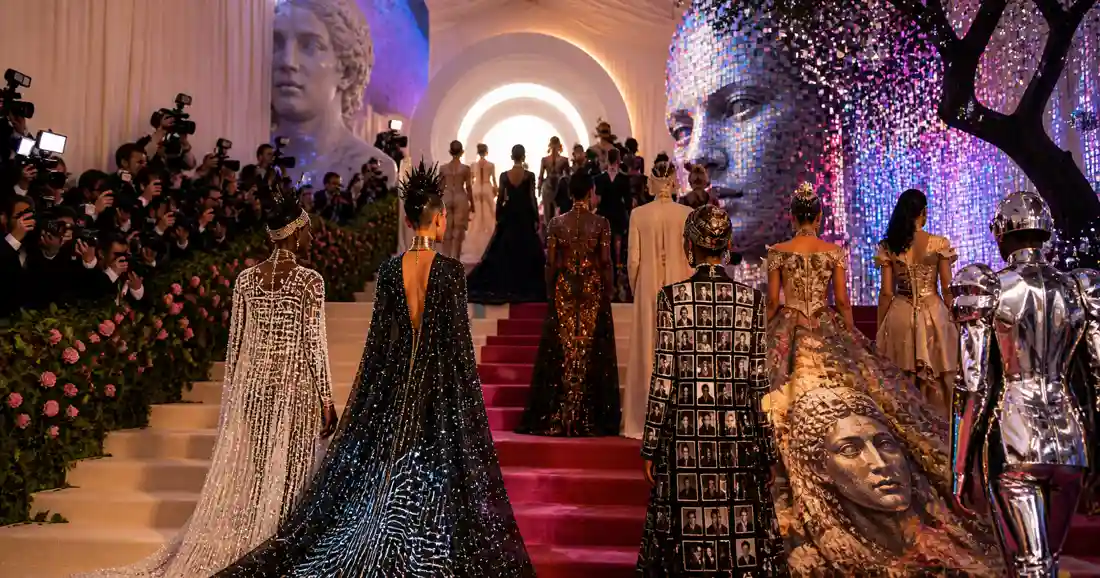
The Met Gala is no longer just a glamorous night on the steps of the Metropolitan Museum of Art. It has evolved into a global cultural signal — a moment where fashion, politics, identity, and technology intersect in a way few events can replicate.
Each year’s theme doesn’t simply guide outfits — it defines the tone of creative expression across fashion, media, and even social discourse for months afterward.
Met Gala 2026 theme: what we know and what it represents
While official details around the Met Gala theme 2026 are still emerging, early discussions within fashion circles suggest a strong conceptual shift toward the relationship between human identity and digital transformation.
The direction appears to be moving beyond traditional historical or aesthetic themes into something more philosophical — exploring how fashion adapts in an era shaped by AI, virtual presence, and fragmented identities.
This is not accidental. It reflects a broader transition in fashion from visual storytelling to conceptual storytelling.
The evolution of Met Gala themes: from archives to abstraction
In previous years, themes often revolved around designers, historical movements, or specific aesthetics. However, recent editions have gradually shifted toward more abstract ideas:
- identity and self-expression
- cultural hybridity
- the role of technology in fashion
- sustainability and future materials
The 2026 direction appears to push this even further — into a space where fashion is no longer just worn, but interpreted as a language of existence in a digital world.
What the 2026 theme could mean in practice
1. Digital identity as fashion
Expect looks that blur the line between physical and virtual selves. Designers may experiment with:
- augmented reality elements
- AI-generated aesthetics
- garments that mimic digital textures or glitch effects
Fashion could become a visual metaphor for online personas — fragmented, layered, and constantly evolving.
2. Post-human aesthetics
A growing trend in high fashion is the idea of the “post-human” — where the body itself becomes a canvas for transformation.
At the 2026 Met Gala, this could translate into:
- exaggerated silhouettes
- biomechanical elements
- designs that challenge the idea of a “natural” human form
This is less about shock value and more about questioning what identity means in a technologically enhanced world.
3. Cultural memory vs. digital future
One of the most compelling tensions likely to appear is the contrast between tradition and innovation.
Designers may combine:
- historical references
- traditional craftsmanship
- futuristic materials
This duality reflects a deeper question:
Can cultural identity survive in a hyper-digital era, or does it transform into something entirely new?
Why this theme matters beyond fashion
Fashion as a mirror of society
The Met Gala has always reflected broader societal shifts. The 2026 theme signals that we are entering a phase where:
- identity is increasingly fluid
- technology shapes self-perception
- physical and digital realities merge
Fashion becomes a tool to process these changes.
The influence of AI and virtual culture
With AI-generated art and virtual influencers becoming mainstream, fashion is no longer limited to physical garments.
The 2026 theme may highlight:
- AI as a co-creator in design
- the rise of digital-only fashion
- the idea that style exists independently of the physical body
This represents a fundamental shift in how fashion is produced and consumed.
My analysis: a turning point for the Met Gala
The Met Gala 2026 theme feels like a transition from spectacle to philosophy.
In earlier years, the focus was often on visual impact — who wore the most dramatic or extravagant look. Now, the emphasis is shifting toward meaning:
- What does the outfit say?
- What concept does it explore?
- How does it relate to the future of humanity?
This is a more mature, intellectually demanding direction for the event.
The risk: when concepts become too abstract
There is, however, a potential downside.
As themes become more conceptual, they risk:
- losing accessibility for the general audience
- becoming overly interpretive
- prioritizing message over visual clarity
The challenge for 2026 will be balance — creating looks that are both thought-provoking and visually compelling.
What to expect on the red carpet
If current trends hold, the Met Gala 2026 could deliver:
- hybrid physical-digital outfits
- interactive or tech-integrated garments
- bold reinterpretations of identity
- less emphasis on traditional glamour, more on conceptual storytelling
In short, the red carpet may look less like a fashion show — and more like a living exhibition of ideas.
Final thoughts
The Met Gala theme 2026 is shaping up to be more than a fashion concept — it’s a reflection of a world redefining itself.
As technology reshapes identity and culture becomes increasingly fluid, fashion is stepping into a new role: not just dressing people, but explaining what it means to be human in a rapidly changing reality.
And if that direction holds, 2026 may be remembered as the year the Met Gala fully transformed from a spectacle into a statement.